


In Texas, a Will is valid if the person making it has legal and testamentary capacity, creates a written document that they intend to serve as a Will, and signs it according to the requirements of Texas law.
What is a Will?
A Last Will and Testament is a legal document that allows you to identify your beneficiaries, nominate a legal guardian for any minor children, dictate how your property will be distributed after you die. It also allows you to nominate an executor, who will manage your estate, pay your debts, expenses and taxes, and distribute your estate according to your wishes.
Every state has statutory requirements dictating what makes a Will valid. Texas is no different.
The rules are rigid. If even one requirement is missed, a document meant to protect your family may not be enforceable. Instead, your property will be distributed according to the Texas Intestacy laws, which follow a statutory formula ceated by the state legislature instead of your personal wishes.
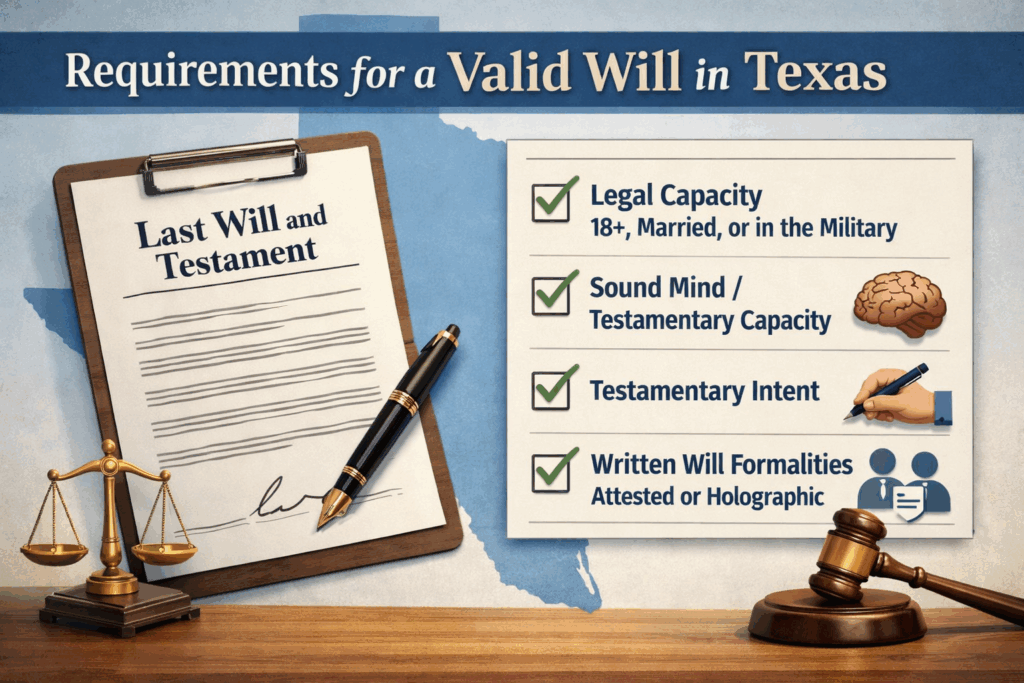
What Makes a Will Valid in Texas?
To be valid in Texas, a Will must meet all of the legal requirements outlined below.
1. Legal Capacity
One of the requirements of a valid Will in Texas is that the testator has legal capacity. This means that person making the Will, known as the testator, must be at least 18 years old, lawfully married, or a member of the military.
2. Testamentary Capacity
In addition to legal capacity, the testator must also have testamentary capacity, or be of “sound mind” at the time the Will is signed. Texas courts have ruled that a testator has testamentary capacity if they understand:
- That they are making a Will
- The effect of making a Will
- The general nature and extent of their property
- The identity of close family members or other natural beneficiaries
- That they are disposing of their property
- How these elements work together as a plan
This standard does not necessarily require perfect memory or good health. A person may be seriously ill and still have capacity. What matters is the testator’s mental state at the moment the Will is executed.
3. Testamentary Intent
The testator must also intend for the document to operate as a Will. Notes detailing the testator’s wishes or informal statements are usually not enough.
4. The Will Must Be in Writing
Texas generally does not recognize oral Wills. To be valid, the Will must be in writing.
The type of formalities required for a written will depend on the type of written Will you have made. Texas recognizes two types of written Wills:
- Holographic Wills: A holographic will is a handwritten Will. To be valid, a testator must write the Will completely in their own handwriting and sign it. A testator can write a holographic will on anything, including stationery or even on a bedroom wall. Witnesses are not required. Although holographic Wills are legal, they often create problems in probate. They are easier to challenge than attorney-drafted Wills.
- Attested Wills: An attested Will is any Will that is not entirely handwritten by the testator. Wills that an attorney prepares fall into this category. According to Section 251.051 of the Texas Estates Code, an attested Will must be:
- Signed by the testator, or by another person at the testator’s direction and in the testator’s presence, and
- Signed by at least two credible witnesses who are at least 14 years old, in the testator’s presence
Must a Will be Notarized to be Valid in Texas?
No. A Will that meets the requirements listed above is valid in the state of Texas, even if it is not notarized. However, most Wills attorneys prepare include self-proving affidavits, which require notarization. Self-proving affidavits don’tmake the Will more valid, but make probate easier.
What is a Self-Proving Affidavit?
A self-proving affidavit is a sworn statement that witnesses and the testator sign in front of a notary public. It’s not mandatory, but serves as presumptive evidence that the testator signed the Will properly. This allows it to be entered into probate without live testimony of the witnesses pursuant to Texas Estates Code Section 251.102.
If a Will is not self-proved, witnesses may need to appear in court to testify during probate. This can be difficult if witnesses cannot be located or are no longer living.
A self-proving affidavit replaces the need for that testimony. It reduces delay and expense during probate.
What Happens if Will Is Not Valid?
If a Will does not meet Texas legal requirements, it cannot be admitted to probate. When that happens, a statutory formula, known as the intestacy statutes, will control who receives your property. Dying without a Will in Texas can result in your property passing in a manner that is contrary to your wishes. It can also increase the cost and complexity of probating the Will.
A valid Will also allows the testator to:
- Name an executor
- Designate guardians for minor children
- Create trusts for beneficiaries
- Specify how debts, expenses, and taxes should be paid
- Control how property is distributed
Do I Need a Lawyer to Make a Will in Texas?
There is no legal requirement to hire a lawyer to create a Will in Texas. However, DIY estate planning is fraught with risk. Errors in execution, ambiguous language, or failure to meet legal requirements can cause the Will to be declared invalid.
Many probate disputes arise from documents that were prepared without legal guidance and do not meet statutory requirements.
Why Work with an Estate Planning Attorney?
An experienced Texas estate planning lawyer can help you navigate these legal requirements to ensure your Texas Will is drafted and executed correctly.
If you are creating a Will or reviewing an existing one, legal guidance can help confirm that the document will function as intended when it is needed.