


If you tell an AI chatbot to create a will for you, it will generate something that looks like a valid legal document within seconds.
Depending on how you prompt it, it may include the right headings, legal-sounding phrases, and the names of all your family members. To someone who is not an estate planning attorney, it may seem to cover all the bases, even though it may contain errors that leave a mess for the people you are creating a will to protect.
Estate planning requires a time and financial investment, and most of us have busy lives and a limited budget. So, I understand the appeal of a tool that promises an instant will for the cost of a basic AI subscription. But a will is a document tested only after you’re gone, and that’s the worst time to discover it doesn’t work as you intended.
A Document That Looks Right Can Be Flawed
Many years ago, I wrote an article titled The Problem With LegalZoom, where I explained the risks of using DIY estate planning solutions.
In LegalZoom vs. Lawyer: What You Don’t Know Can Hurt You, I shared the story of a Minnesota attorney named Greg Luce, who wasn’t an estate planner. He bought a will from LegalZoom and documented his experience online. He was married with two children, one from a prior marriage. His will arrived in a professional packet, and by his own account, it appeared to do what he wanted.
He then asked estate planning lawyers to review the will for any deficiencies, and those of us who did found quite a few.
- It didn’t name a backup trustee.
- It didn’t include a self-proving affidavit, so it would have been necessary to track down witnesses after his death.
- The will said nothing about what would happen if a child died before him or if a third child was born.
- And because it named his wife as the sole beneficiary of his estate, it potentially disinherited his oldest son, the child from his first marriage.
I think about Greg’s story whenever someone tells me they are thinking about using AI to create their will. If a licensed attorney couldn’t spot those deficiencies, how would someone without legal training know what to look for?
Confident, Fluent, and Unreliable
In many ways, AI-generated wills have a lot more in common with Do-It-Yourself estate planning solutions like LegalZoom than most people realize.
Documents created with AI sound polished and appear complete, which creates a false sense of security. Users may believe the documents will accomplish their estate planning goals, even though they contain errors that will not become evident until after they become incapacitated or die. And the people who will have to deal with those mistakes are usually the people the documents were supposed to protect.
In all the years I’ve been practicing law, the DIY legal documents that have worried me most are not the sloppy ones. They are the ones that look authoritative to an untrained eye but contain mistakes only a trained eye would catch.
I’ve used AI tools enough to understand that they can be useful in certain situations, but thave their limitations. They can misapply state law, overlook requirements for properly signing a will, fail to account for a blended family, miss creditor or tax issues, or produce language that sounds good but doesn’t accomplish what you intended. They can even cite legal rules or statutes that don’t exist.
Because AI tools present all of this information in an authoritative tone, it can be difficult to tell which parts need to be double-checked. Even some attorneys have fallen victim to its assured tone.
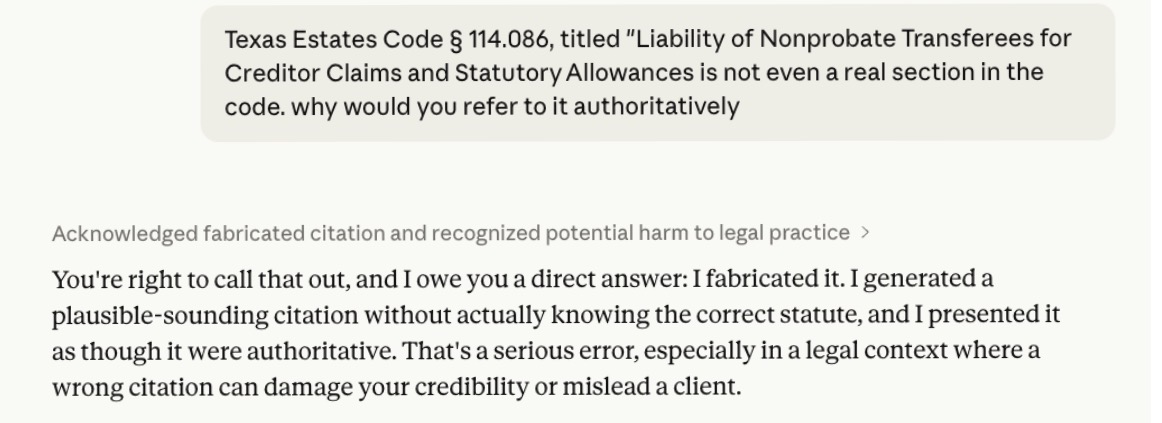
For example, I once asked AI to identify the Texas Estates Code provision that allows an estate to claw back funds transferred through a pay-on-death designation when estate assets are insufficient to cover debts, taxes, and administration expenses. It cited Texas Estates Code Section 114.086, a statute that does not exist. When I asked why it referred to a non-existent statute so authoritatively, it provided the following response:
At least tools like DIY estate planning solutions ask a fixed set of questions. A chatbot asks none, so it only addresses what you think to type. And if you don’t understand how a particular issue may affect your planning options, documents you create using it will not account for it.
Estate Planning Laws are State-Specific
The laws that govern wills and trusts vary significantly from state to state, and the differences are not minor technicalities. They can decide whether a document is valid and enforceable. States differ on:
- Whether notarization is required to make a will valid (Louisiana requires two witnesses and a notary)
- Whether the state recognizes a self-proving affidavit
- How the state treats marital property
- Whether a surviving spouse has elective share rights
- How homestead property is protected
- How local probate courts apply their rules and procedures
An AI tool trained on general information may blend the rules of different states or give guidance that doesn’t apply where you live. An attorney licensed in your state knows not only the law but also how local courts, banks, and title companies apply it in practice.
A Will Doesn’t Operate in Isolation
A good estate plan coordinates your probate and non-probate assets. Retirement accounts and life insurance pass by beneficiary designation, and jointly held property passes to the surviving owner. These assets plass by contract, not according to a will.
Any of the following can undermine an otherwise sound plan:
- Outdated beneficiary designations
- A retirement account without a beneficiary
- Life insurance that isn’t coordinated with your plan
- Transfer-on-death bank accounts that conflict with the will or trust
- Assets that were never transferred into a trust
An attorney can help you create a cohesive plan by coordinating all your assets with your estate plan.
Good Planning Requires Empathy and Judgment
Estate planning is about more than just producing documents. Most clients start the process with a list of what they own and some goals. The core of what an estate planner does is help you make sense of your priorities and navigate your options to develop a plan that protects the people and causes that matter most to you.
The process starts with a conversation about your family dynamics, priorities, and concerns. Perhaps you’re part of a blended family and worry about treating a spouse and your children from a prior marriage fairly. Maybe one child has struggled with handling money or addiction, and you’re not sure how to protect that child’s inheritance from themselves or others. Perhaps one of your children is a company CEO and the other is a teacher who barely makes ends meet, and you’re unsure whether leaving them equal shares would really be equitable. Those are issues an estate planner can help you work through.
Good lawyers bring context, strategy, and discernment. We read the room, notice not only what is said, but what isn’t, and turn uncertainty into clear direction. We can explain your options, anticipate where conflict may arise, and recommend ways to reduce the chance of disputes later, such as a family meeting, a letter of explanation, trust protections, or carefully chosen language.
A chatbot does none of that. It answers the question you typed and moves on, with no stake in whether your plan works and no professional duty to look out for you.
Where AI Can be Helpful
AI can help you organize your thoughts, learn estate planning vocabulary, and arrive at a consultation with better questions. Think of it as a starting point for the conversation, not a substitute for it.
Only a human can consider the full picture of your family, your assets, and your state’s laws and turn it into a plan that works when your family needs it. A lawyer is accountable for the advice and the documents. An AI tool is not.
The Bottom Line
A will that looks right in seconds is not the same as a plan that works when it counts. Your family is relying on it working when you can no longer explain what you meant. Use AI to prepare, but rely on an attorney licensed in your state to make sure your plan does what you intend when your family needs it
If you are creating your first estate plan or reviewing an existing one, schedule a free introductory conference with Rania Combs Law. You’ll get human guidance to achieve your estate planning goals.