


LegalZoom and other do-it-yourself document preparation services want you to believe that the process of preparing a Will is as easy as filling in the blanks on standardized forms.
- They lure you with a cheap product and a process that takes less than half an hour to complete.
- They assure you with testimonials of customers professing that their product has given them “peace of mind.”
- They provide you with a portal that gives you a “general understanding of the law” even though the information it contains is “not guaranteed to be correct, complete or up-to-date.”
- They suggest that the document you get from their company will be just as effective as one an attorney creates by garnering endorsements from famous lawyers like Robert Shapiro.
In short, despite a disclaimer that their document preparation services are not a substitute for the advice of an attorney, they try to convince you that the advice of an attorney is simply not necessary.
Do-it-yourself Wills provide a false sense of security
Several years ago, a Minnesota attorney named Gregory Luce, who was the Practice Development Director at the Minnesota State Bar Association, agreed to buy a Will on LegalZoom. He recorded his progress doing so in a series on his Practice Blawg to compare the service and Will he obtained from LegalZoom with the process of getting a Will prepared by an attorney.
At the time Greg recorded the series, he was married and had two children: one from a previous marriage and the other from his current marriage. Even though he was a licensed attorney, he did not practice estate planning. His experience provided a glimpse at how even educated consumers may be lulled into “peace of mind” by a document with significant flaws.
Is the advice of an attorney necessary in the preparation of a will?
Greg posted a video on his blog that documents his experience of obtaining a Will through LegalZoom. I wish I had downloaded it before Greg pulled down his blog because it was a good example of how easy it is for even an attorney to make significant mistakes.
As I watched the video, the following highlighted statement stunned me:
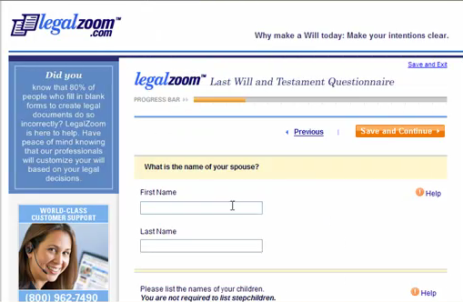
But LegalZoom is not a law firm. It cannot review your answers for legal sufficiency, draw legal conclusions, provide legal advice or apply the law to the facts of your particular situation.
On the top left-hand corner of the page, LegalZoom reveals that 80 percent of people who fill in blank forms to create legal documents do so incorrectly. Despite this disclaimer, LegalZoom tries to reassure its customers that professionals are there to help; that customers can have “peace of mind” knowing that LegalZoom professionals will customize their Will based on their legal decisions.

Consequently, LegalZoom resorts to providing only general information on legal issues commonly encountered and offers guidance in some instances by indicating that a majority of its customers have answered a question a certain way.
The problem is that everyone’s situation is unique. Just because the majority of customers have answered a question a certain way, for example, doesn’t necessarily make it right for your individual circumstances.
So if the document contains serious legal mistakes, you’ll never know because they will not become apparent until you die. And the people left to deal with the mistakes are the people you’re probably creating your Will to protect.
If it seems too good to be true, it probably is
According to Greg, his LegalZoom Will arrived in a very professional packet that contained a booklet titled “Guide to Your Last Will and Testament,” a “Property Worksheet” for listing all assets in one place, and instructional sheets titled “Notarizing Your Documents,” Executor’s Guide,” and “Guardian’s Guide.”
Besides the fact that the Will excluded one of his sons from the testamentary trust he created for his children, a potentially costly mistake, Greg writes that the Will he received looked good, noting that the Will did what he thought it should.
But since he is not an estate planning attorney, Greg posted a copy of the Will online. He then asked estate planning lawyers to review it and point out any issues that may be problematic. Not surprisingly, there were plenty of problems.
Problematic Issues with Do-It-Yourself Wills
Below is a summary of just a few of the problems some attorneys who commented pointed out:
- The Will failed to include an alternate trustee in the event the named trustee predeceases him or is unable or unwilling to serve.
- It did not include a self-proving affidavit. This would make it necessary to track down witnesses after his death to prove up the validity of the Will.
- It failed to provide guidance about beneficiary designations on non-probate assets that pass outside the Will.
- Additionally, it did not address the contingency of his children predeceasing him or the birth or adoption of a third child.
- It also failed to include a spendthrift provision, which protects the trust assets from the trust beneficiary’s creditors.
Another problem I noticed was that the Will potentially disinherited Greg’s oldest child. Greg was part of a blended family, and his wife was not his oldest son’s mother.
As the sole beneficiary of his estate, she would have complete control over the assets. Her Will would control how those assets would be distributed after her death. She could choose not to share any of the property she inherited from Greg with her stepson.
Do-it-yourself wills are not worth the risk
Attorneys do more than draft a document. They advise you on the best way to protect your family and preserve and distribute your assets according to your wishes.
Yes, the advice of an attorney costs more. But eighty percent of people who fill in blank forms to create legal documents do so incorrectly. Are you going to beat the odds? Are you willing to take the risk?