


If you die without a Will in Texas, also known as dying intestate, your probate property may pass in ways you did not anticipate. When someone dies without a Will in Texas, the Texas intestacy laws, a formula set by the Texas legislature, determine who inherits that property.
The answer depends on the family members who survive you, whether you are married, whether you have children from another relationship, and whether property is community or separate property. Not every asset follows intestacy rules: assets with a valid beneficiary designation, survivorship feature, or trust arrangement may pass outside probate.

What It Means to Die Without a Will in Texas
Most of us know we need a Will. But life is busy. None of us expects to die today, tomorrow, or anytime soon. So procrastinating does not seem risky.
But when there is no valid Last Will and Testament, Texas law steps in with its own plan. The intestacy laws, found in Chapter 201 of the Texas Estates Code, control who will inherit probate property, in what shares they will inherit, and the order in which relatives have priority.
These laws reflect the Texas legislature’s best guess about what an “average” Texan might want. But no statute can know the details of your life. The law does not know that you intended to leave more to a child with special needs, that your closest bond is with a niece rather than a sibling, or that you wanted your long-time partner to be able to stay in your home.
Intestacy is a “one size fits most” plan. But “one size fits most” rarely fits anyone very well. This article outlines the general rules for who inherits when there is no Will in Texas. A specific outcome can turn on facts that are not apparent from a family tree alone, so it is not a substitute for individual legal advice.
Who Inherits if You Die Without a Will in Texas?
Texas intestacy law generally gives priority to a surviving spouse and descendants. If there is no surviving spouse or descendant, the law looks to parents, siblings and their descendants, and then more distant relatives. The following summaries address common situations.
Who Inherits When a Single Person Without Children Dies Without a Will in Texas?
Under Section 201.001 of the Texas intestacy laws, if you are single, have no children, and die without a Will in Texas, the Texas intestacy laws generally distribute your estate as follows:
- If both parents are alive, they inherit in equal shares.
- If only one parent is alive and you do not have any siblings or descendants of siblings, your entire estate passes to the surviving parent.
- If one parent is living and you have surviving siblings or descendants of siblings, the surviving parent inherits one-half and the siblings or their descendants share the other half.
- If neither parent is living but you have surviving siblings or their descendants, the estate passes to them according to the statutory formula.
- If you have no parents, siblings, or descendants of siblings, the estate is divided between relatives on your mother’s side and your father’s side as provided by statute.
- If no qualifying heirs exist, the State of Texas may receive the estate.
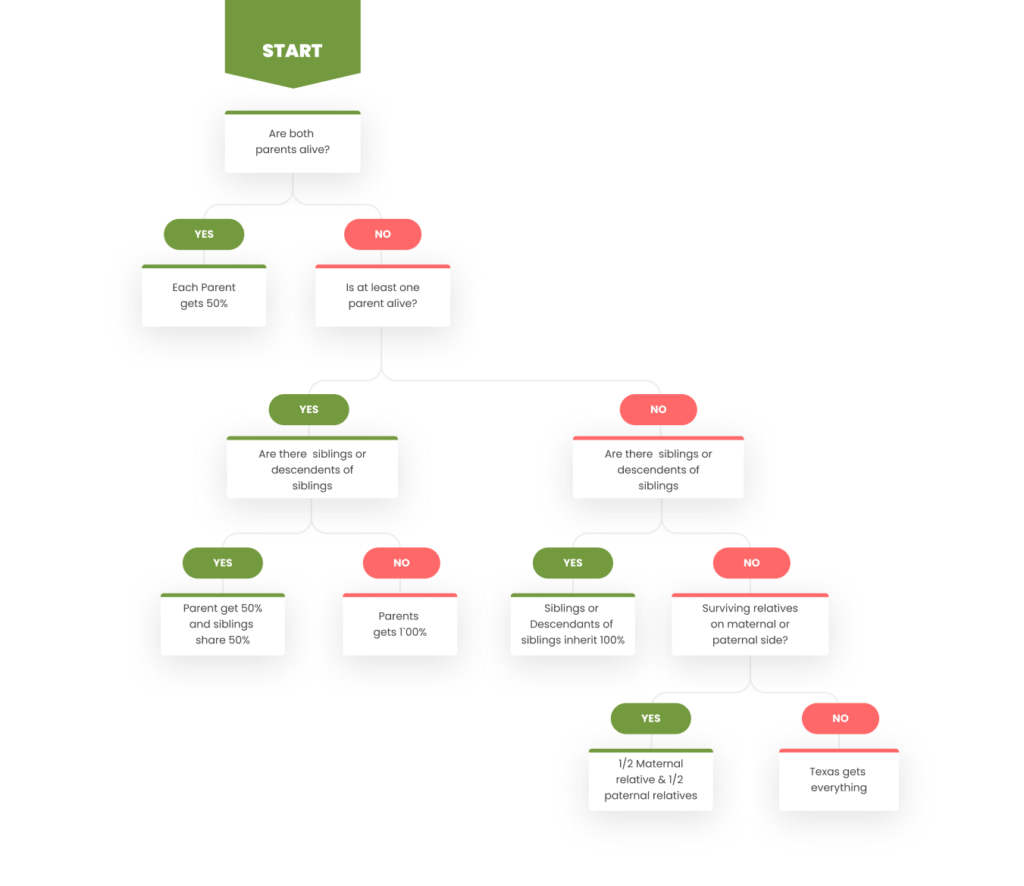
On paper, this structure may seem orderly. In real life, it often conflicts with modern family arrangements. For example, a long-term unmarried partner is not automatically an heir under Texas intestacy law simply because the couple shared a home or lived together.
Joint ownership does not necessarily mean the surviving owner automatically inherits the deceased owner’s share. Unless a deed or account includes effective right-of-survivorship language or another transfer arrangement, the deceased owner’s interest may pass to legal heirs instead. That outcome can leave a surviving partner facing uncertainty about whether they can stay in the home they shared.
Who Inherits When a Single Parent With Children Dies Without a Will?
If you are single, have children, and die without a Will, your descendants generally inherit your estate. When all surviving descendants are in the same generation, such as all being your children, they generally inherit in equal shares. If descendants are in different generations, the law uses a statutory system that can allow grandchildren to inherit the share their deceased parent would have received.
For example, if you had three children and all survive you, each generally inherits one-third. If one child dies before you but leaves two children, those grandchildren may split their parent’s one-third share. If none of your children survive you and six grandchildren do, each grandchild may inherit one-sixth.
While this approach may feel fair in theory, it offers no flexibility. It does not allow you to adjust distributions based on need, responsibility, a disability, or personal circumstances. It also does not name a guardian for minor children or select a trusted person to manage an inheritance for them.
What Happens When a Married Person Dies Without a Will in Texas?
Intestacy can be more complicated for married couples than people expect. How much property a surviving spouse receives depends in part on whether the property is classified as community property or separate property, and whether the deceased spouse has children from a prior relationship.
Community Property
Community property is generally property spouses acquire during their marriage, except property a spouse receives as a gift or inheritance. Under Texas Estates Code Section 201.003, if a married person dies without descendants, the surviving spouse generally inherits all community property. The same is generally true when all of the deceased spouse’s children are also children of the surviving spouse.
However, when the deceased spouse has children from a prior relationship, the surviving spouse does not automatically inherit the deceased spouse’s one-half interest in community property. That portion generally passes to the deceased spouse’s children. Many surviving spouses are shocked to learn that stepchildren can own an interest in property they expected to remain entirely theirs.
Separate Property
Separate property generally includes assets owned before marriage or received by gift or inheritance. According to Texas Estates Code Section 201.002, if the deceased person has children, the surviving spouse generally inherits one-third of separate personal property and a life estate in one-third of separate real estate. The children inherit the remaining interests.
If the deceased person has no children but does have surviving parents, siblings, or descendants of siblings, the surviving spouse generally inherits all separate personal property and one-half of separate real estate. The other half passes to the relatives identified by the statute. These results may be very different from what a couple assumed.
Do Texas Intestacy Laws Control All Property?
No. Not all assets pass through probate. Some property transfers at death under its own beneficiary designation, ownership feature, or trust arrangement, regardless of whether a Will exists. These are commonly called non-probate assets and can include:
- Property or accounts held with an effective right of survivorship
- Retirement accounts, such as IRAs and 401(k)s, with designated beneficiaries
- Life insurance policies with designated beneficiaries
- Payable-on-death and transfer-on-death accounts
- Assets properly titled in a living trust
These assets may pass directly to the named beneficiary or surviving owner rather than under Texas intestacy rules. Beneficiary designations and account titles should be reviewed regularly because they can override the distribution plan a person assumes will apply.
Why Having a Will Matters
Creating a Will gives you the power to decide who will receive your property. You can decide who receives personal effects and how property will pass to family members, friends, caregivers, or charities, even though they would not be entitled to property under the intestacy laws.
A Will can also nominate an executor, nominate guardians for minor children, and work alongside beneficiary designations and trusts. It provides a plan tailored to your family rather than the statutory default.
Frequently Asked Questions About Dying Without a Will in Texas
Does a spouse inherit everything in Texas without a Will?
Not always. The result depends on whether property is community or separate property and whether the deceased spouse had children from another relationship. A surviving spouse may share ownership with the deceased spouse’s children or other relatives.
Do children automatically inherit when a parent dies without a Will in Texas?
Children are generally among the first heirs under Texas intestacy law. Their exact share depends on whether there is a surviving spouse, the type of property involved, and whether there are descendants of a deceased child.
Does an unmarried partner inherit in Texas without a Will?
An unmarried partner does not automatically inherit under Texas intestacy law merely because the couple lived together or owned property together. A Will, trust, beneficiary designation, survivorship agreement, or other valid planning arrangement may be needed to provide for that partner.
How can I prevent Texas intestacy law from controlling my estate?
A valid estate plan can state who should inherit and who should manage the estate. For many people, that includes a Will, updated beneficiary designations, and, when appropriate, a trust or other planning documents.
Talk With a Texas Will Attorney
If you have questions about how intestacy laws would apply to your situation, or whether your current plan will accomplish your goals, a Texas Will attorney can help you understand your options. You can also learn more about the requirements of a valid Will in Texas.