

A Last Will and Testament does not necessarily have to be typed and prepared by an attorney to be valid in Texas.
Texas recognizes a handwritten Will—called a holographic Will—if it satisfies the applicable legal requirements.
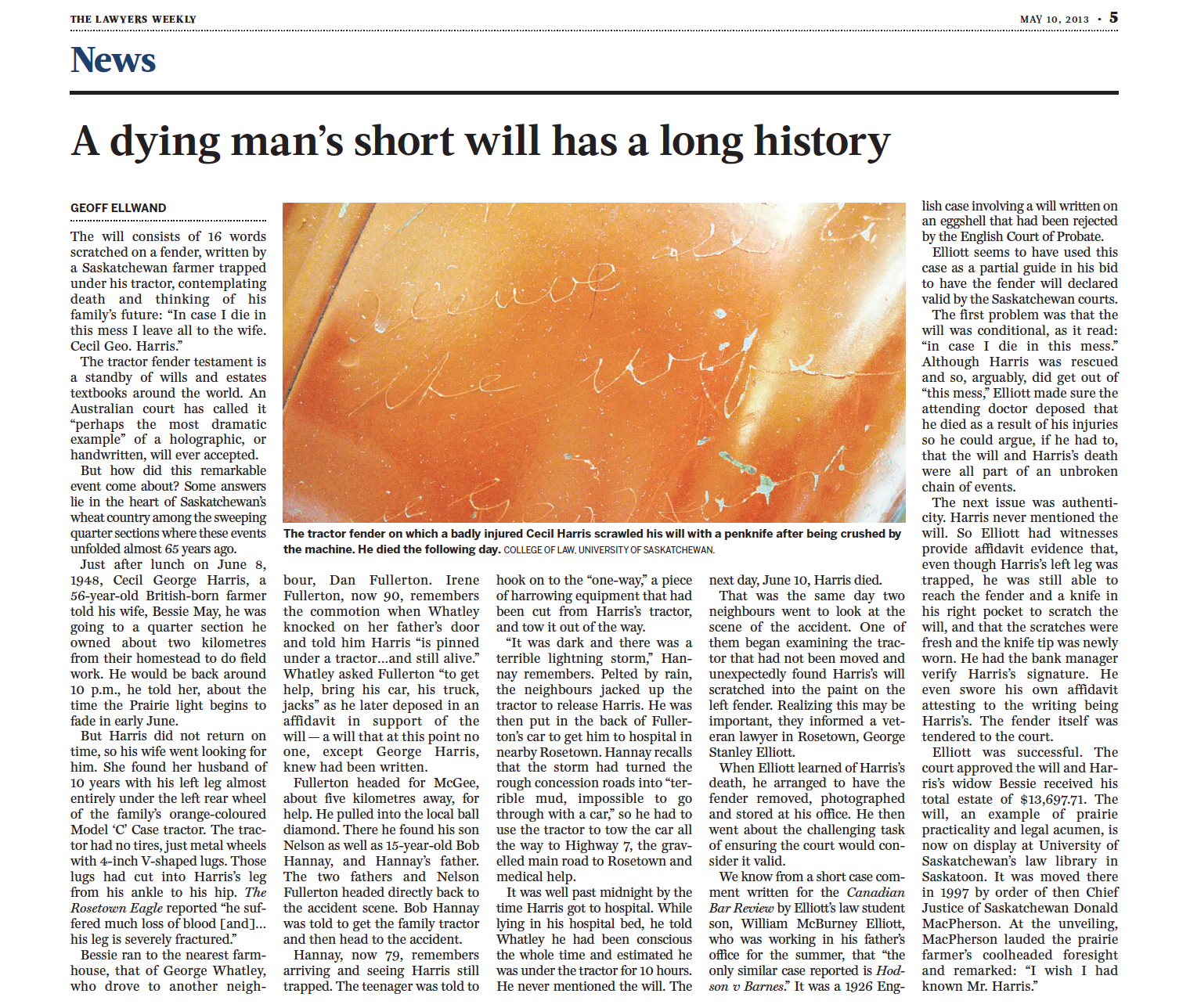
That flexibility has led to some unusual examples. People have written purported Wills on scraps of paper, walls, and even parts of vehicles. But the fact that Texas recognizes holographic Wills does not mean every handwritten statement about who should receive your property is legally effective—or that using a handwritten Will is always a good idea.
Questions also arise about other unconventional ways of expressing final wishes:
- Does printing in block letters count as handwriting?
- Can part of the Will be typed?
- Does a holographic Will need witnesses?
- Does it need to be notarized?
- Can you add a self-proving affidavit later?
- Can you make an oral Will in Texas?
- Can you simply record your Will on video?
Texas law treats each of these situations differently.
What Is a Holographic Will in Texas?
A holographic Will is a Will written wholly in the handwriting of the person making it, who is known as the testator.
Unlike a formal attested Will, a qualifying Texas holographic Will does not need to be witnessed.
To be valid, however, the document must still satisfy the other requirements applicable to a Texas Will, including testamentary capacity and testamentary intent.
For a broader explanation of those requirements, see What Are the Requirements of a Valid Will in Texas?
What Are the Requirements for a Holographic Will in Texas?
A Texas holographic Will generally must:
- Be wholly in the testator’s handwriting;
- Be signed by the testator;
- Be created by someone with the legal and testamentary capacity to make a Will; and
- Reflect testamentary intent—meaning the testator intended the writing to operate as a Will.
The document does not need attesting witnesses merely because it is a holographic Will.
Does a Holographic Will Need Witnesses in Texas?
No.
Texas law specifically exempts Wills written wholly in the testator’s handwriting from the ordinary witness requirement.
This is one of the principal differences between a holographic Will and a formal attested Will.
A formal Will that is not entirely handwritten by the testator generally requires at least two credible witnesses who are at least 14 years old and who sign in the testator’s presence.
A qualifying holographic Will does not.
Does a Holographic Will Have to Be Notarized?
No.
Notarization is not a requirement for the validity of a Texas holographic Will.
However, a testator may choose to make a holographic Will self-proved by attaching or annexing a qualifying affidavit.
Self-proving does not make an otherwise invalid Will valid. Instead, it can simplify the process of proving the Will after the testator dies.
Can a Holographic Will Be Written on Anything?
Potentially, yes.
Texas law focuses on whether the document satisfies the legal requirements for a Will rather than requiring a specific type of paper.
Historically, courts in various jurisdictions have encountered purported Wills written on unconventional surfaces, including walls and vehicle parts.
But novelty should not be confused with good planning.
A Will written on an unusual object may create practical problems involving:
- Preservation of the original;
- Proof of authenticity;
- Legibility;
- Storage;
- Interpretation; and
- Presentation to the probate court.
A conventional, clearly drafted estate planning document is usually far easier for beneficiaries and an Executor to administer.
What Counts as “Handwriting” for a Holographic Will?
The important requirement is that the operative Will be written by hand by the testator.
It does not have to be written in cursive. Hand printing, block lettering, cursive writing, or a combination of handwritten styles can potentially qualify.
The important issue is whether the writing was physically created by the testator’s own hand.
Can I Print My Holographic Will in Block Letters?
Yes.
“Handwritten” does not mean “written in cursive.”
If you personally print the words by hand in block letters, that writing can still constitute handwriting for purposes of a holographic Will.
The concern is authorship, not penmanship style.
Can I Type Part of a Holographic Will and Handwrite the Rest?
This is where problems frequently arise.
A Texas holographic Will must be wholly in the testator’s handwriting.
If you download or print a form containing preprinted language and simply fill in the blanks by hand, you should not assume that the document qualifies as a holographic Will.
A partially typewritten document may instead need to satisfy the execution requirements for an attested Will. For that reason, a fill-in-the-blank form completed without witnesses can create significant validity problems.
What About Letterhead, Stationery, or Preprinted Material?
The presence of incidental printed material on paper does not necessarily answer whether a Will qualifies as holographic.
The more important issue is whether the testamentary provisions—the language that actually expresses the testator’s wishes—are wholly in the testator’s handwriting.
But mixing handwriting and printed Will provisions creates an avoidable legal issue.
If there is any doubt about whether a document satisfies the holographic-Will rules, the safer option is to properly execute a formal attested Will.
Does a Holographic Will Have to Be Dated?
Texas law does not generally require a date merely for a holographic Will to be valid. Nevertheless, dating the Will is strongly advisable.
A date can become important if:
- More than one Will is discovered;
- There is a question about which document was created most recently;
- The testator’s capacity changed over time;
- The testator married or divorced; or
- Someone argues that an earlier Will was later revoked.
A simple date can prevent significant uncertainty later.
Does a Holographic Will Expire?
No. A valid Texas holographic Will does not automatically expire merely because time passes.
It can remain effective until it is revoked or superseded according to Texas law.
However, an old Will may no longer reflect the testator’s family circumstances, property, relationships, or estate planning goals.
A Will should therefore be reviewed periodically even if it remains technically valid.
Can You Add a Self-Proving Affidavit to a Holographic Will?
Yes.
Texas law specifically permits a holographic Will to be made self-proved during the testator’s lifetime.
The testator can attach or annex an affidavit stating, in substance, that:
- The instrument is the testator’s Will;
- The testator met the applicable age, marital-status, or military-service requirement when the Will was executed;
- The testator was of sound mind; and
- The testator has not revoked the Will.
The affidavit is made under oath and notarized.
Why Make a Holographic Will Self-Proved?
Self-proving can make probate easier.
A holographic Will that is not self-proved generally requires evidence establishing that the Will is wholly in the testator’s handwriting.
Texas probate law may require testimony from witnesses familiar with the testator’s handwriting when the Will is not self-proved.
A properly completed self-proving affidavit can reduce the evidentiary burden and avoid the need to locate handwriting witnesses later.
Does a Self-Proving Affidavit Make a Bad Holographic Will Valid?
No.
A self-proving affidavit is an evidentiary tool. It does not cure fundamental defects in the Will itself.
For example, self-proving does not fix:
- Ambiguous distribution language;
- An ineffective attempt to dispose of property;
- Missing contingency provisions; or
- A document that does not otherwise satisfy the requirements for a holographic Will.
How Is a Holographic Will Proved in Probate?
If the Will is properly self-proved, probate can be simpler because the statutory affidavit supplies evidence regarding execution.
If it is not self-proved, additional proof may be required.
Texas law generally requires proof by people familiar with the testator’s handwriting when an unsigned-witness holographic Will must be established in probate.
This can create problems if:
- People familiar with the handwriting have died;
- Those people cannot be located;
- Family members disagree over authenticity; or
- The handwriting changed because of age or illness.
For information about administration after death, see our Texas probate services.
Are Holographic Wills More Likely to Be Contested?
They can create more opportunities for disputes than professionally drafted and formally executed Wills.
A holographic Will may raise questions about:
- Whether the handwriting is genuine;
- Whether the testator intended the document to be a Will;
- Whether the testator had capacity;
- Whether someone exercised undue influence;
- Whether later markings altered or revoked provisions;
- What ambiguous phrases mean; and
- Whether the document disposes of the entire estate.
The absence of witnesses can remove one source of evidence about the circumstances surrounding execution.
A Holographic Will Can Work—But at What Cost?
One of the original articles in this series described a man who reportedly wrote a Will on a paper towel leaving his estate to his girlfriend.
The Will was ultimately upheld despite a challenge by his former spouse and children.
Legally, the handwritten Will worked. Practically, however, it generated litigation involving multiple attorneys.
That illustrates an important distinction:
A Will can ultimately be declared valid and still be a poor estate planning solution.
The purpose of estate planning is not merely to create a document capable of surviving litigation. Ideally, the plan should also:
- Clearly express the testator’s wishes;
- Address foreseeable contingencies;
- Reduce ambiguity;
- Make probate efficient;
- Reduce opportunities for disputes; and
- Protect beneficiaries appropriately.
How Can a Holographic Will Accidentally Create Problems?
A person making a handwritten Will may understand whom they want to benefit without understanding all of the legal provisions necessary to accomplish that goal.
Common problems include failing to address:
- What happens if a beneficiary dies first;
- What happens to property acquired later;
- The disposition of the residue of the estate;
- Who should serve as Executor;
- Whether the Executor should serve independently;
- What happens if the named Executor cannot serve;
- Minor beneficiaries;
- Beneficiaries with disabilities;
- Blended-family issues;
- Guardianship nominations;
- Tax issues; and
- Potential conflicts among beneficiaries.
For an example of how do-it-yourself planning can unintentionally affect a child, see Do-It-Yourself Estate Planning Mistake Disinherits Child.
What Happens if a Holographic Will Does Not Include a Residuary Clause?
A residuary clause disposes of probate property that is not otherwise specifically addressed in the Will. A handwritten Will that lists only a few specific gifts may leave other assets undisposed of.
Those assets may then pass under Texas intestacy law rather than to the people the testator assumed would receive them.
This is one of the ways a document can be valid yet still fail to accomplish the testator’s complete estate planning objectives.
Can a Holographic Will Disinherit a Child?
Texas generally allows a competent testator to choose beneficiaries and disinherit heirs, subject to particular statutory rights and limitations that may apply in certain situations.
But a handwritten Will can create uncertainty over whether an omission was intentional.
If excluding a close family member is deliberate and a contest is foreseeable, careful drafting and execution can become especially important.
When Is a Holographic Will Particularly Risky?
A handwritten Will may be particularly risky if:
- You have minor children;
- You are part of a blended family;
- You have a beneficiary with disabilities;
- You want to create a trust;
- You own a business;
- You have significant or complicated assets;
- You own property in more than one state;
- You want to make unequal gifts among children;
- You anticipate a Will contest;
- You want to intentionally disinherit a close relative; or
- Your estate plan involves significant tax or creditor considerations.
In those circumstances, a professionally drafted Texas Will can provide considerably greater clarity.
Can I Make an Oral Will in Texas?
Not under current Texas law.
An oral Will is sometimes called a nuncupative Will. Texas historically recognized oral Wills in very limited circumstances, but that law changed.
Oral Wills made after September 1, 2007 are not valid in Texas.
Very old oral Wills made before that date may still be evaluated under the law that existed when they were made, but this has little practical relevance for someone creating an estate plan today.
Can I Make a Deathbed Will by Telling My Family What I Want?
No.
A verbal statement made to children, friends, nurses, or other people about who should inherit your property does not substitute for a valid written Texas Will.
Even if several people hear the statement and agree about exactly what you said, Texas’s current Will statutes generally require a written instrument.
If someone is facing an urgent medical situation but still has testamentary capacity, a properly executed written Will should be used rather than relying on oral instructions.
Are Videotaped Wills Valid in Texas?
A video recording by itself is not a valid Texas Will.
Recording yourself on a phone or camera saying who should receive your property does not satisfy the statutory requirement for a written Will.
A video therefore cannot substitute for either:
- A properly executed attested Will; or
- A valid holographic Will.
Can a Video Be Used Alongside a Written Will?
Potentially, yes.
A recording of a Will-signing ceremony can sometimes provide evidence about the circumstances surrounding execution.
For example, a video may potentially show:
- The testator appearing alert and oriented;
- The testator explaining the purpose of the Will;
- The signing ceremony;
- The presence of witnesses; or
- The apparent absence of obvious coercion.
But video evidence can also create complications.
A recording may capture statements, hesitation, prompting, family interactions, or other details that later become evidence in a Will contest.
Videotaping a signing ceremony should therefore not be viewed as automatically beneficial in every case.
Can I Make a Video Explaining Why I Left Someone Out of My Will?
You can record an explanation, but whether doing so is strategically advisable depends on the circumstances.
A video explanation does not replace the Will and does not independently control how property passes. It can also create evidence that challengers may attempt to use.
If you anticipate a dispute over your estate plan, discuss the potential benefits and disadvantages of explanatory recordings with an estate planning attorney before making one.
Are Electronic or DocuSign Wills Valid in Texas?
Texas has not generally replaced its statutory Will-execution requirements with ordinary electronic-signature procedures merely because electronic signatures are accepted for many other transactions.
A Will should not be assumed valid merely because it was typed, electronically signed, or completed through a general electronic-signature platform.
Similarly, a document typed on a phone or computer is not a holographic Will because it is not wholly in the testator’s handwriting.
For current planning, follow the execution requirements applicable to the type of Texas Will being created.
Holographic Will vs. Formal Attested Will
| Issue | Holographic Will | Formal Attested Will |
|---|---|---|
| Must be written? | Yes | Yes |
| Must be handwritten? | Wholly in the testator’s handwriting | No |
| Witnesses required? | No | Generally at least two credible witnesses age 14 or older |
| Notary required for validity? | No | No |
| Can be self-proved? | Yes | Yes |
| Common practical concern | Ambiguity, proof of handwriting, missing provisions | Execution mistakes if formalities are not followed |
Common Mistakes With Holographic and Nontraditional Wills
Typing Part of a Purported Holographic Will
A holographic Will must be wholly in the testator’s handwriting.
Assuming a Notary Makes the Will Valid
Notarization does not cure a document that fails the underlying Will requirements.
Failing to Sign the Will
A holographic Will still needs the testator’s signature.
Using Vague Language
Phrases such as “divide things fairly” or “take care of everyone” can create serious interpretation problems.
Forgetting a Residuary Clause
Property not disposed of under the Will may pass by intestacy.
Failing to Plan for a Beneficiary Who Dies First
Backup beneficiaries and contingency provisions are important.
Relying on Oral Instructions
Current Texas law does not recognize newly created oral Wills.
Assuming a Video Is a Will
A videotaped statement does not replace the required written document.
Failing to Update the Will
Marriage, divorce, deaths, births, new property, and changing relationships can make an old handwritten Will inconsistent with your current wishes.
Frequently Asked Questions About Holographic Wills in Texas
What is a holographic Will?
A holographic Will is a Will written wholly in the testator’s own handwriting.
Are handwritten Wills legal in Texas?
Yes. Texas recognizes a qualifying holographic Will if it is wholly in the testator’s handwriting and satisfies the other legal requirements for a Will.
Does a handwritten Will need witnesses in Texas?
No. A qualifying holographic Will does not need attesting witnesses.
Does a holographic Will need to be notarized?
No. Notarization is not necessary for validity, although the testator can add a notarized self-proving affidavit.
Can I write my Will in block letters?
Yes. Printing by hand can qualify as handwriting. It does not have to be cursive.
Can part of the Will be typed?
A Will relying on Texas’s holographic-Will exception must be wholly in the testator’s handwriting. Mixing typed Will provisions with handwritten language can prevent the document from qualifying as holographic.
Does a holographic Will have to be dated?
A date is not generally required for validity, but including one is strongly advisable.
Can I make my holographic Will self-proving?
Yes. Texas law allows a testator to attach or annex a qualifying self-proving affidavit during the testator’s lifetime.
Can I make an oral Will in Texas?
No. Oral Wills made after September 1, 2007 are not valid under current Texas law.
Is a videotaped Will valid?
No. A video recording alone does not satisfy Texas’s written-Will requirements.
Can I video my Will-signing ceremony?
You can, and a recording may sometimes provide evidence regarding capacity or execution. However, it can also create evidence relevant to a future contest, so videotaping should be considered carefully.
Is a holographic Will as legally valid as a formal Will?
If it satisfies Texas law, a holographic Will can be legally valid. The concern is often not whether Texas recognizes the form, but whether the handwritten document is clear, complete, easy to prove, and appropriately designed for the testator’s circumstances.
Should You Use a Holographic Will in Texas?
A holographic Will can be legally effective and may be useful in limited circumstances, particularly when someone needs to document testamentary wishes quickly and cannot immediately execute a formal Will.
But ease of execution comes with tradeoffs.
Because most people who write their own Wills are not trained in estate planning, the document may fail to address contingencies, fiduciary appointments, minor beneficiaries, trusts, blended-family issues, or probate-administration provisions.
The result can be a Will that is technically valid but expensive to interpret and administer.
If your goal is not merely to create a valid document but to make administration easier for your family, a carefully drafted and formally executed Will is generally the more reliable approach.
Create a Texas Will That Clearly Carries Out Your Wishes
Texas gives people substantial flexibility in how they create a Will, including recognition of qualifying handwritten Wills.
But flexibility should not be mistaken for simplicity.
A short handwritten document may save time when it is created while generating far greater cost and uncertainty after death.
An experienced Texas Will attorney can help you create a Will that satisfies the legal formalities, clearly disposes of your property, addresses contingencies, and integrates with the rest of your Texas estate plan.